News - Press Release

Electric propulsion is redefining ROV performance, reliability, and total cost of ownership across the subsea lifecycle.
Subsea innovation is often framed as a search for incremental efficiency. The shifts that matter most, however, are the ones that compound and quietly reshape cost structures, operating models, and long‑term fleet strategy.
Electric ROV propulsion is one of those shifts.
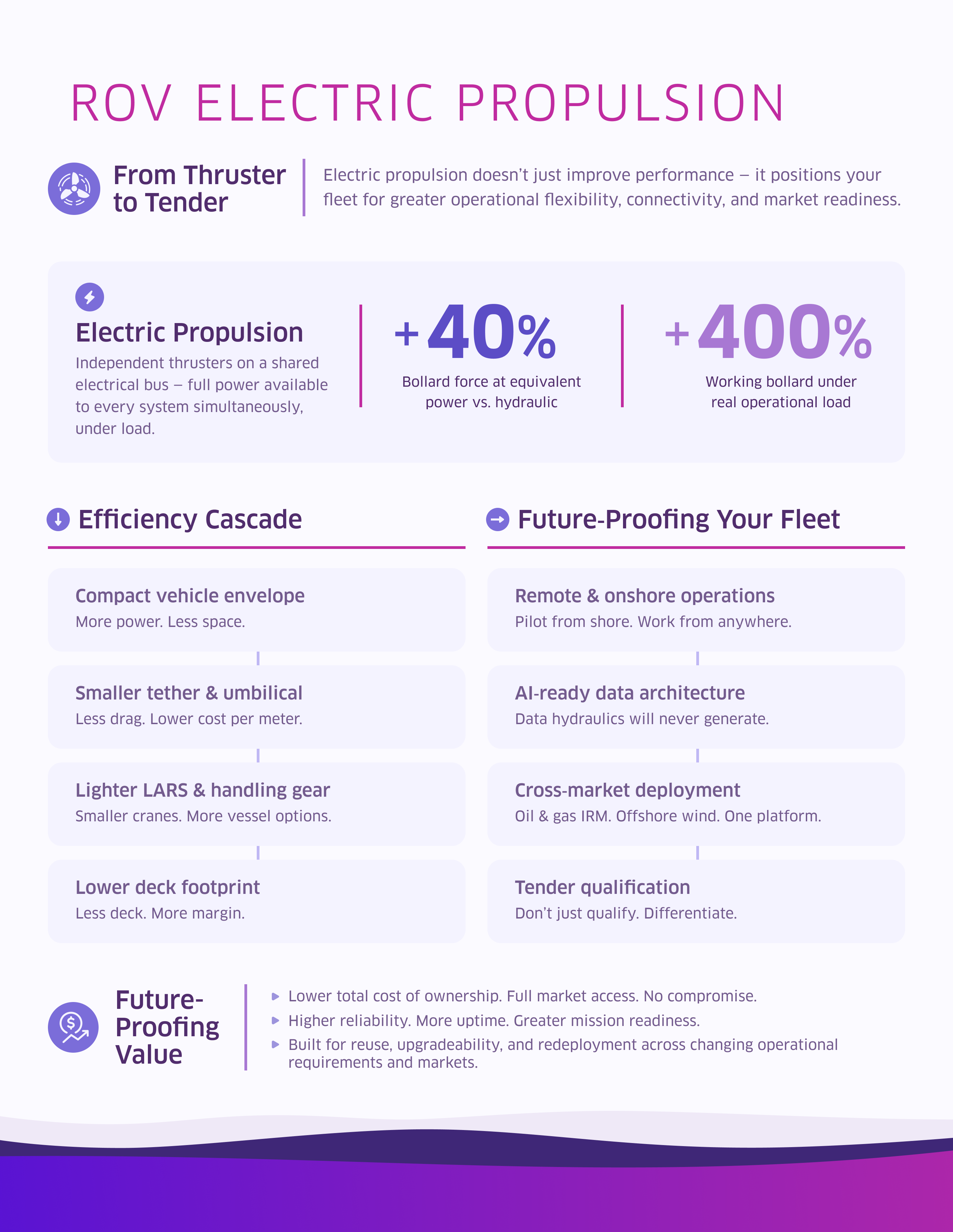
The conversation usually starts with thrust, and for good reason. Electric drivetrains deliver materially higher usable bollard force per kilowatt, enough that a 150‑horsepower electric work‑class ROV can match the flight performance of a 250‑horsepower hydraulic predecessor. This gain shows up in current, at depth, during work. Productivity improves where it matters.
The deeper story is operational expenditures. Operators who track failure data closely identify hydraulics as the leading source of unplanned downtime and maintenance hours. In some fleets, hydraulic‑related tasks account for roughly 80% of routine dive checks. Removing the HPU, valve packs, and hydraulic thrusters eliminates the fluid lines, fittings, and seals that create that burden. The vehicle becomes simpler, and labor, which is the dominant cost in any ROV operation, decreases with it.
Electric architecture also changes how maintenance decisions are made. Native diagnostics across thrusters and power systems enable condition‑based monitoring instead of calendar‑driven teardown. A healthy thruster is not pulled apart unnecessarily, and it is not reassembled with a new fault introduced in the process. That shift alone removes a meaningful share of avoidable interventions.
The same digital foundation makes vessel‑to‑vessel remote piloting practical, supports automation, and allows platforms to move across inspection, repair, maintenance, decommissioning, and emerging deepwater scopes without reconfiguration.
Higher system efficiency—particularly in thrust relative to available power—supports a smaller, more workable ROV form factor for the same performance. This delivers a clear advantage in shallow, high current, jacket-bound environments where larger hydraulic platforms struggle. It also enables reuse of high-cost components such as umbilicals, tethers, and handling systems, making the transition a targeted upgrade rather than a fleet-wide rebuilding.
Taken together, electric propulsion is not a component upgrade but a strategic pivot that lowers total cost of ownership while positioning fleets for markets and operating models that are still taking shape. In subsea operations, that level of optionality is becoming a competitive requirement rather than a luxury.
More news
-

News | October 05, 2026
TechnipFMC Qualifies 66kV Dynamic Inter-Array Cable for Floating Wind
-

News | October 01, 2026
More Pumping Time, Less Idle Time
-

News | September 02, 2026
Electric propulsion is rewriting the rules of subsea work